
Died of Wounds August 1915
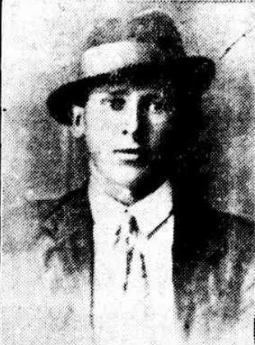
We remember and pay tribute to Private Raymond Leslie Goldsmith.
Raymond Goldsmith was born in 1894, the second son of Ernest and Eliza Goldsmith of Wyong, New South Wales. Known to friends and family as “Ray”, he came from a pioneering family that had been in the Wyong district for several generations. Ray was educated at the local public school and was reportedly “always a keen sport, indulging a good deal in football and fishing”. He grew to just over six feet tall and, somewhat unusually, was tattooed, bearing flags and a heart on his left upper arm. He later moved to Yass, where he found work on the railway duplication works that began around 1914. |
 |
Ray’s grandfather, John, had a service medal from his father who had fought in the Crimean War in the 1850s, and had almost certainly shown his grandchildren the medal. Ray enlisted in the Australian Imperial Force shortly after the outbreak of war in 1914, and wrote to his mother, saying, “Mother, it is my duty to go. My great grandfather fought for us in the Crimean War, and I deem it my duty to help the Empire.”
 |
Ray Goldsmith was posted to the 3rd Battalion, and after a short period of training in Australia sailed with the first contingent on 19 October 1914. After a brief stop in Albany, Western Australia, the 3rd Battalion proceeded to Egypt, arriving in early December, and continued training in the desert. The 3rd Battalion formed part of the second and third waves of the landing at Gallipoli on 25 April 1915. The men rushed ashore to secure the shaky front line on the heights above the beach, and spent much of the following days establishing a position. On 19 May the Turks conducted a major counter-attack to try to remove the Australians. During this attack, Private Goldsmith was shot in the right shoulder, and was evacuated from the peninsula later the same day. |
After about a month in hospital, Private Goldsmith returned to Gallipoli on 26 June 1915. At this time the 3rd Battalion was largely involved in defending the front line, with short period of rest in the limited space available out of Turkish reach.
On 25 July Private Ray Goldsmith was struck in the head by shrapnel from a bursting Turkish shell. He was not immediately evacuated as he had been the first time he was wounded, but was treated on the peninsula. His wounds proved too severe, however, and he died on 1 August 1915.
In Australia, Ray’s mother Eliza received a message in August to say her son had been wounded, and the next day a second message arrived to say he was dead. She wrote to Senator George Pearce, saying “I know I am only one mother among many thousands that are mourning for their beloved soldier sons, but I would be extremely grateful if you could get any information for me regarding the last days of my darling son … it would be a comfort to me to know the nature of his wounds and where he died and was buried.”
There was little information to send to Eliza Goldsmith, although authorities later ensured the family received pictures of Ray’s grave. Ray Goldsmith was buried in Beach Cemetery, Anzac, where he lies today under the words “in memory of [the] loved son of Mr & Mrs Goldsmith, Wyong”. He was 21 years old.
His name is listed on the Roll of Honour at the Australian War Memorial, among almost 62,000 Australians who died while serving in the First World War.
Complied by Meleah Hampton - Historian, Military History Section, Australian War Memorial
Ray's story was shared as one of the many stories of service and sacrifice told at the Australian War Memorial. Watch his story as told at the now remember Private Raymond Leslie Goldsmith, who gave his life for us, for our freedoms, and in the hope of a better world.
The Last Post Ceremony commemorating the service of (1537) Private Raymond Leslie Goldsmith, 3rd Battalion, AIF, First World War can be watched below,
https://s3-ap-southeast-2.amazonaws.com/awm-media/collection/AWM2019.1.1.97/video/7373258.MP4